|
|
In Dub 1
In Dub exists between two states.The artist’s appropriation of the phrase is used to describe the possibilities of a relationship between visual art and audio,where the work on show has been recontextulised to create a new space in which the audience is able to visualise sound.
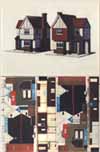
The work Cordless is a canvas print showing the front and rear view of a mock Tudor house placed next to a cordless speaker.
A mobile phone conversation (intercepted on short- wave radio) is relayed between two Scottish women dissecting the worst New Year ever.Everything about the work is disembodied.The background habitat that would anchor the house to a situation has been taken away,leaving the building to float on the canvas.The voices have no physical existence;their accent and informal discussion on family disagreements over allocation of drink bears no relation to the clinical Tudor model.The house and the conversation operate without origin.
Further along the gallery is the physical manifestation of the segway:the seamless joining together of two pieces of music.
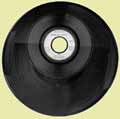
The vinyl single True by the clean cut Spandau Ballet has been physically placed into an LP, resulting in the vinyl hybrid that is exhibited.This new record has the potential for a different sound,if only the needle could follow the new channel.But the viewer can see that it is pinned to the wall so hearing the track remains unrealised.
The advent of vinyl meant that a sound could be owned,then digitally recording came along to remaster that sound,erasing the crackle and the human imperfection from it. Superseded by Cd,the vinyl record was obsolete in mainstream music. Long Player combines the knowledge of both audio eras.
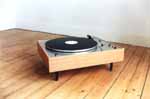
The mock teak finish of its box recalls the days when the enthusiast could buy and assemble their own HiFi kit,while the brushed aluminium top alludes to stylish HITec.Long Player however is outsize:the vinyl is as large as the period of time that the sound was continuously recorded for,and the record player is a prototype able to play it.The record is four hours long;a recording made traditionally using a needle and wax cylinder. The resulting sound however was made with the noise from the newer technology of mixing desk,microphone,video recorder, computer and record desk.The record itself is beautiful to look at.It has the perfect blank white label of the standard DJ press promo but there are small spaces in the groove where the recording breaks up.Long player operates in the space created through this difference,between the visible human transmission of sound and the perfected technology.Moreover, as a prototype it has the potential to be expanded to any amount of time -’Two or three times he had reconstructed a whole day:he had never hesitated, but each reconstruction had required a whole day.'2
Teenage Kicks provides a visual panorama of sound.
The aggressive recording of the Undertones classic,through use of American computer software,has been translated in to a pastoral scene of a gently unfolding 2m stretch of cliffscape.The solid landscape of Teenage Kicks exists in the space created by the transference of information from one medium to another.In this translation,‘the landscape is coded.'3
The viewer in the gallery can stand and see something that does not exist to be seen.
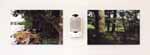
The fluctuation of nothing consists of two photographs with a cordless speaker in between.
The speaker relays a description of sound by using the artists interview with a man who has spent the last 40 years making environmental recordings in the Highlands.His archive of sounds all recorded on open reel,range from those that will never occur again,like the last Kessock Ferry journey,to the tiny phenomena of the Greenshank hatching or the less special occurrence of a drunk man in an Italian chip shop.He obsessively hunts sound in order to get a feeling for a place,to create an audio picture. The enormity of this bank of accumulated sound information is like a Borges story:all possibilities of sound could be there,down to the archive man’s pursuit of the sound of nothing.
The photographs in the Fluctuation of Nothing show a natural forest habitat containing alien objects.A pair of cordless headphones hang on a branch,a rifle mike stands in a forest glade.There is no explanation for this intervention.The disembodied sound equipment appears strange as it is out of its natural context.However, the juxtaposition of technology and forest does allow for the possibility in coming across the headphones on a walk that is in the middle of nowhere and finding that they play something.They could offer information,they could highlight the audio landscape that they are situated in or provide a soundtrack from a completely different environment.
Lying on top of a podium in the gallery space is itself a pair of cordless headphones.Mirroring the photograph,there is the potential for the gallery-goer to put them on and move freely between the works that they are observing.The headphones offer dichotic listening:in one ear is the conversation between the two women in Cordless,in the other is the interview with the environmental sound recordist use in The Fluctuation of Nothing.The headphones,as an aid,offer an immediate way to experience the space between the viewer and the work.They offer a different level of seeing.
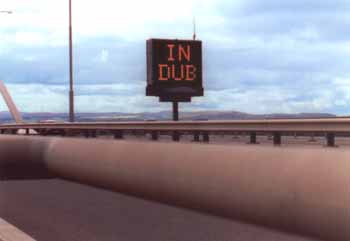
The poster size photo manipulation City Dub shows the potential to change the factual road information of dot matrix signs to a more emotive text.
The signs are located in mundane places where people move between points of destination and situation.Here, a sign in a featureless street reads‘Between two moments bliss is ripe'. 4
During the editing stage of the conversation about sound,the artist in an effort to clean up the recording,cut out all the pauses between the sentences and was left with a hard drive bin of ums and ahs.Afterwards on playing the piece back,the result did not appear to have the natural flow of the original.Although he had erased all superfluous blips and pauses,and had a smooth recording,he had also cut out a very human sound that punctuates the natural progression of any conversation.So he edited the pauses back in again.In Dub exists in this space.The work creates the time between two states where visual sound can occur. The artist is involved in a continuous process which looks for this space.As the sound hunter in The Fluctuation of Nothing points out‘let the tape run,you might get something out of the blue that has never happened in your life before‘.
Jenny Brownrigg , 1998
1.The show title: In Dub , is taken from the
1980 Linton Kwesi Johnson album ‘LKJ in Dub‘
and acknowledges the sonic art of the early dub
reggae producers and musicians through their
experimental studio engineering.
2.From Funes the Memorious,a short story in
Labyrinths by Louis Borges.
3.The
terminal Beach, J.G. Ballard.
|